The Cognitive Science of Story-Based Learning
Most language programs treat the brain like a hard drive: they try to upload data through lists, charts, and repetitive drills. But the human brain isn’t wired to store isolated data points. It’s wired for narrative.
Your brain was not built for flashcard decks.
It was built for what happens next.
Long before written language existed, humans transmitted complex information — survival patterns, social rules, cultural memory — through narrative. Story is not a delivery mechanism your brain tolerates. It is the one it was designed for.
This is not a metaphor. Cognitive scientists call it narrative transportation: the measurable shift in attention, emotion, and memory encoding that occurs when a listener or reader is drawn into a story. When you are transported, your brain processes language differently — deeper, faster, with less conscious resistance. You stop decoding and start experiencing.
That is exactly when acquisition happens.
The Cognitive Science of Story-Based Learning explores the research behind why serialized fiction, character-driven narrative, and emotionally engaging content outperform structured exercises for long-term language internalization. If you have ever wondered why you can quote a film but forget a vocabulary list — this is where that question gets answered.
The mechanism is real. The research is solid. And once you understand it, the way you think about English development changes permanently.

The Science of Story-Based ESL Acquisition: Why Narrative Comprehension Outperforms Grammar Drills
Cognitive science explains why narrative-based learning outperforms grammar drills. Neural coupling, emotional engagement, and sustained attention activate durable acquisition.

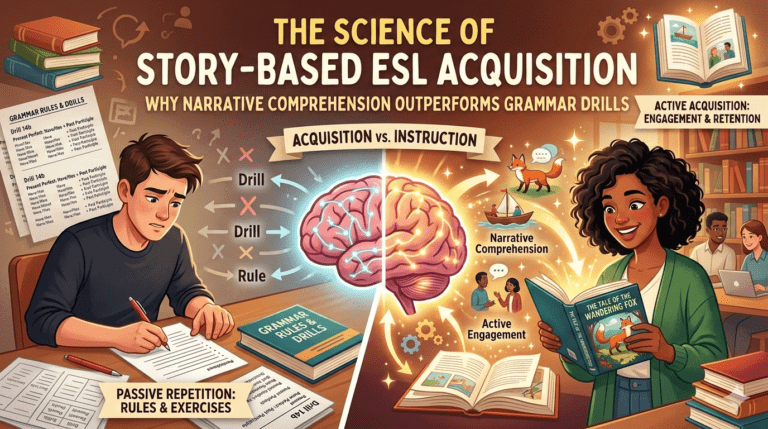

Story-Based Learning isn’t just a “creative” approach—it is a cognitive necessity for high-level acquisition. By anchoring English structures within a narrative arc, we move from short-term memorization to long-term neural integration.
The Neuroscience of the Narrative: Why Stories Work
When you listen to a list of vocabulary, only the language-processing parts of your brain (Broca’s and Wernicke’s areas) are activated. But when you listen to a compelling story, your brain lights up as if you were actually experiencing the events yourself. This is known as Neural Coupling.
Through the lens of Cognitive Science, storytelling provides:
- Contextual Anchoring: New words aren’t “definitions”; they are tools used to solve a protagonist’s problem.
- Dopamine-Driven Retention: The emotional peaks of a story trigger dopamine release, which signals the hippocampus to “save” the surrounding information.
- Reduced Cognitive Load: Instead of managing 50 different grammar rules, your brain manages one cohesive mental model—the plot.
The “SITREP” Reality: A Lesson from 27 Years in the Field
In my 27 years in the military, I learned that a “Situation Report” (SITREP) is far more effective than a manual. Why? Because a SITREP is a story. It has a beginning, a conflict, and a resolution. When things went wrong in high-stress environments, we didn’t recall “Rule 4, Paragraph B.” We recalled the story of the last time someone faced that exact challenge.
In the Profe Community, I apply this same “tactical narrative” logic. We don’t study “The Past Perfect Tense.” We follow a narrative where a professional has to explain a past mistake to a board of directors. Your brain treats that story as a rehearsal for your own life. That is the difference between knowing English and owning it.
Moving Beyond the “Children’s Book” Stigma
Many professionals shy away from story-based learning because they associate “stories” with fables or graded readers. At Profe Studios, we reject that. We use sophisticated, “high-eustress” narratives designed for the B1–C1 learner.
Our Profe Radio content is built on the “90/100 Rule”: the stories are 90% comprehensible, leaving 10% for “desirable difficulty”—the exact cognitive sweet spot where acquisition happens. We provide the research-backed “Story-Silo” so you can stop studying and start acquiring.